Reason #15: Appreciating beauty is a proof of God?

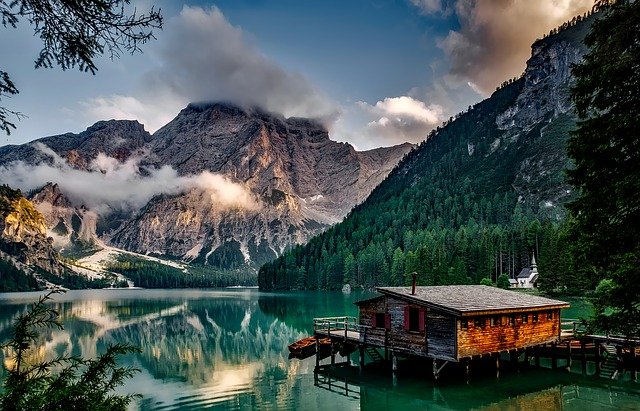
Did you notice what’s strange about the concept of traveling to see a natural attraction? We literally go thousands of miles and spend hundreds or thousands of dollars just to look at some natural objects. We spend hours and days worth of traveling just to look at mountains, oceans, lakes, falls, or stars.

Why though? Sure, they are beautiful, but what’s the benefit? Do they do anything for us? Do they talk or interact with us? Yet, when we go and see them, we feel better and are left in awe.

When you think about it, there’s no true reason to appreciate beauty, especially when you take all the sacrifices of travel into account. It is something specific to humans. If this is just a material world, with every creature doing things for some benefit, why are we moved by beauty? Matter and atoms do not create the mechanism to be moved by beauty, so why are we?

As the Argument From Beauty suggests, perhaps a Higher Being gave us this inherent quality to appreciate beauty, and perhaps it is directing us to find the source of all beauties, which is God Himself.

Perhaps God also is the One with the Ultimate beauty. As Prophet Muhammad (ﷺ) said,

“Verily, Allah is beautiful and He loves beauty.”

[Source: al-Mu’jam al-Awsaṭ 6906. Grade: Sahih (authentic) according to Al-Albani]
Reason #14: Ayatul Kursi is a literary miracle?

Ayatul Kursi is the 255th Ayah in Surah Al-Baqarah. It is composed of 9 sentences or parts.

  1. Allah! There is no god ˹worthy of worship˺ except Him, the Ever-Living, All-Sustaining.
  2. Neither drowsiness nor sleep overtakes Him.
  3. To Him belongs whatever is in the heavens and whatever is on the earth.
  4. Who could possibly intercede with Him without His permission?
  5. He ˹fully˺ knows what is ahead of them and what is behind them,
  6. but no one can grasp any of His knowledge – except what He wills ˹to reveal˺.
  7. His Kursi (chair or footstool) encompasses the heavens and the earth,
  8. and the preservation of both does not tire Him.
  9. and He is the Most High, the Greatest.

Now check this out:

1. Allah! There is no god ˹worthy of worship˺ except Him, the Ever-Living, All-Sustaining.9. And He is the Most High, the Greatest.
2. Neither drowsiness nor sleep overtakes Him.8. and the preservation of both does not tire Him.
3. To Him belongs whatever is in the heavens and whatever is on the earth.7. His Kursi encompasses the heavens and the earth,
4. Who could possibly intercede with Him without His permission?6. but no one can grasp any of His knowledge – except what He wills ˹to reveal˺.

5. He ˹fully˺ knows what is ahead of them and what is behind them

—————–

Can you fathom what you just saw? Can we, in an unbiased way, just appreciate the symmetry here?

The first and last sentences both have something in common – each has 2 names of Allah.

In the second row, both are about the subject of watching over something and not getting tired or sleepy over it.

In the third row, both are about the heavens and the earth. However, what’s beautiful to add is that the 3rd part is talking about ownership and the 7th is talking about the kingdom. Both are about control, but ownership is about property and kingdom is about people, so both aspects of power are covered!

In the fourth row, both parts are statements about Allah and the only exception to each of them.

Then finally the kicker, which is the 5th and middle sentence – He ˹fully˺ knows what is ahead of them and what is behind them. It is as if God is saying He knows what are the sentences before and what are the sentences after. How can someone think of speaking or writing something like that?

  • This was beautifully explained by Nouman Ali Khan in this video –